Bridging the gaps with a sustainable hybrid MPD-solar power system for forest fire monitoring
For a sustainable and efficient method of providing sensors energy in the monitor system, renewable energy is considered primarily.
The primary inspiration comes from the question:
"How do we utilize local natural energy sources for a reliable energy solution?"
Considering the natural environment of forests, this system is based on a novel source of power: Plant-Derivative Metabolic Potential Difference
Metabolic Potential Difference (MPD) collects energy from a difference in charges in a plant due to its photosynthetic metabolism.
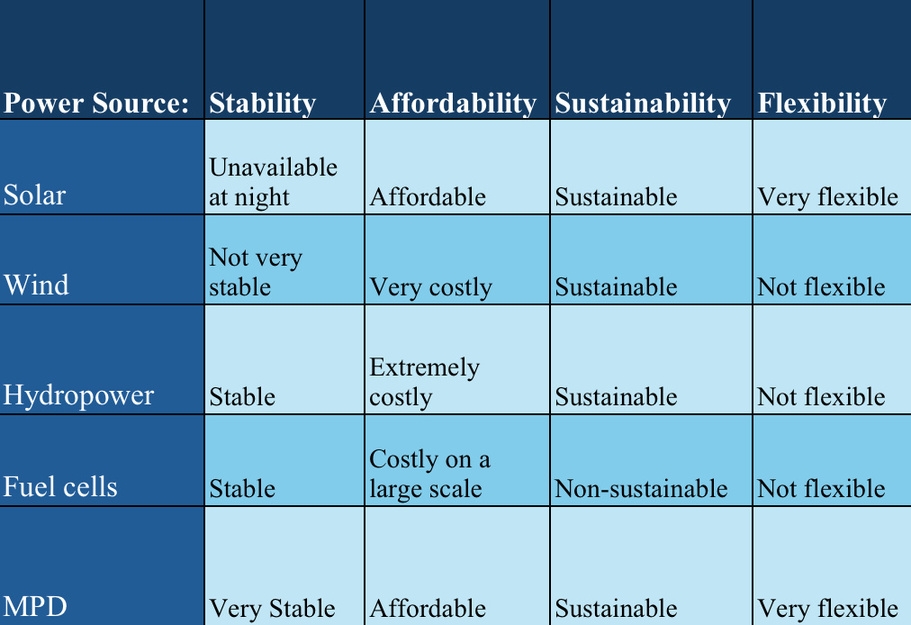
Diagram showing ionic environment from photosynthetic metabolism (H+, K+, Ca(HCO₃)₂, Citrate) creating 50-250 millivolts between zinc electrode (inserted into tree above ground) and copper electrode (in moist soil near roots), connected to 12V rechargeable battery

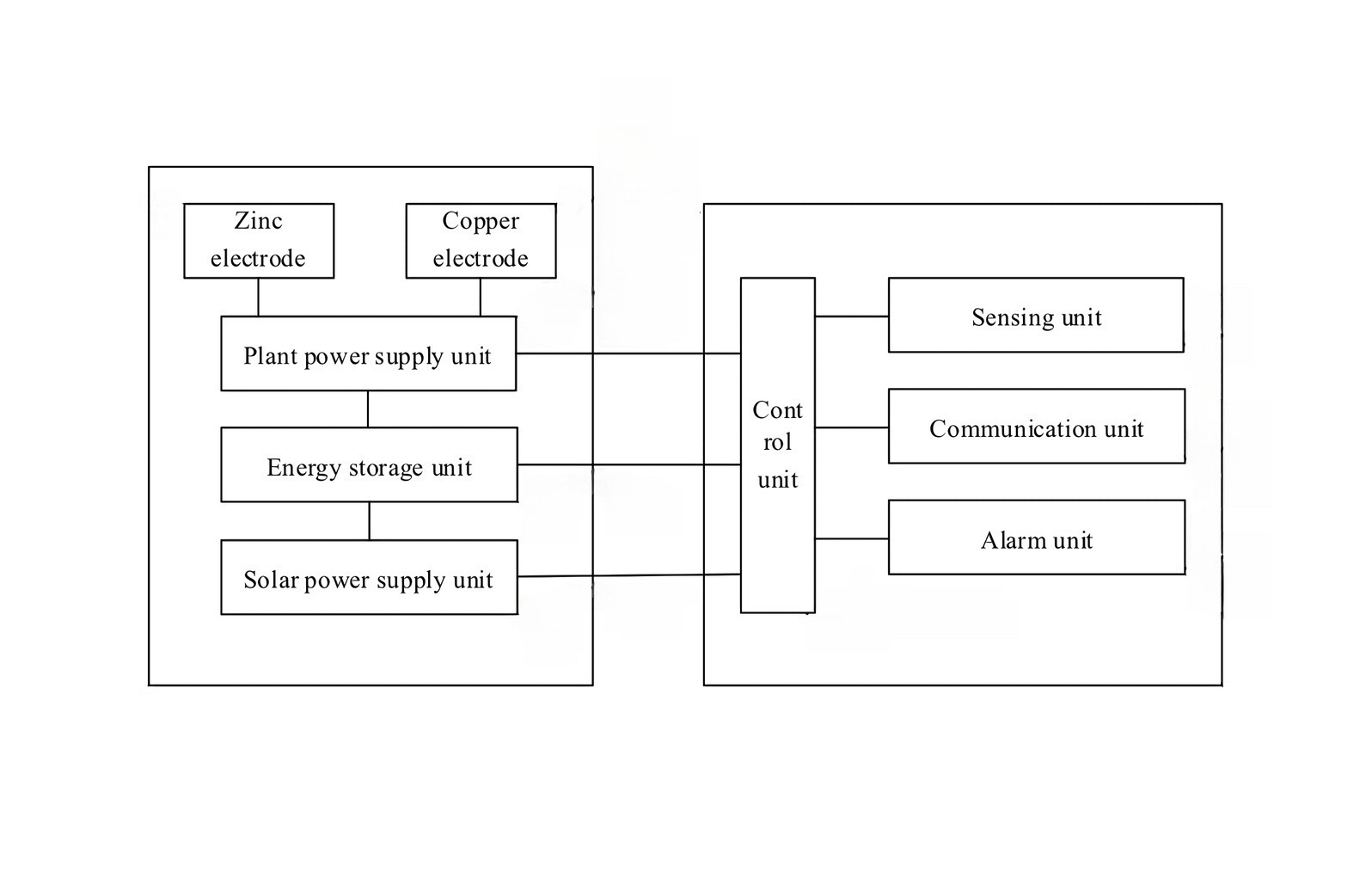
System diagram showing MPD-Solar Hybrid Energy (4 units) → 12V Battery → ESP-32 Mainboard (190 mA) → LoRa Communication (40 mA) → Receiving Station (100 m), with sensors: MQ-2 Smoke (350 mA max), MQ-7 CO (150 mA max), DHT-11 Temp/Humidity (2.5 mA), and 5.5 mA buzzer
Creating a self-sustaining, low-cost forest fire detection system powered by nature itself
| Power Source | Stability | Affordability | Sustainability | Flexibility |
|---|---|---|---|---|
| Solar | Unavailable at night | Affordable | Sustainable | Very flexible |
| Wind | Not very stable | Very costly | Sustainable | Not flexible |
| Hydropower | Stable | Extremely costly | Sustainable | Not flexible |
| Fuel cells | Stable | Costly on a large scale | Non-sustainable | Not flexible |
| MPD | Very Stable | Affordable | Sustainable | Very flexible |
A systematic six-step approach to develop and validate the Blaze Scout system
Design the logistics of the harnessing MPD energy and provide basic formulas
Select and integrate hardware components to build a control circuit that utilizes the energy harnessed for sensors and communication
Develop a structure that combines an energy providing system and monitor sensor system that also protects the internal components
Assess the feasibility of harnessing MPD energy with a total of 24 hour experiment
Validate the power generation of the energy solution and sensor communication and calculate the feasibility of using the hybrid energy system for continuous power
Analyze and compare the costs of the project with existing solutions, listing directions for optimization and future research
Using MPD power with solar power to provide energy for a forest monitoring system - world's first implementation of plant metabolic energy for wildfire detection
The system is able to be implemented on any tree in many different areas as long as the tree maintains a regular metabolism
The device is around 25×15×10 cm, lightweight and compact, allowing flexible placement and rapid deployment in remote forest areas
Only $80 USD per unit - significantly cheaper than conventional solutions, enabling large-scale deployment
There is no reliance on a battery swapping regime, and the energy generated could completely power each device's power consumption with a 22% energy buffer
Enables flexible expansion to improve coverage - approximately 52 devices needed to monitor one acre of forest