Theoretical Design

A Self-Sustaining Power System Based on Energy Balance

Fundamental Logic Behind MPD

The MPD Power Supply Unit generates a stable electrical potential difference between two electrodes by utilizing charged ions (such as H⁺ and K⁺) from organic acids (e.g., citric acid, malic acid) produced during plant photosynthetic metabolism.

This is achieved by placing a zinc electrode into a tree incision and a copper electrode into the soil, enabling continuous current output. It operates unaffected by weather or day-night cycles, providing round-the-clock power.

Since the energy is derived from the plant's natural metabolism, the process produces no carbon emissions, aligning with green monitoring principles.
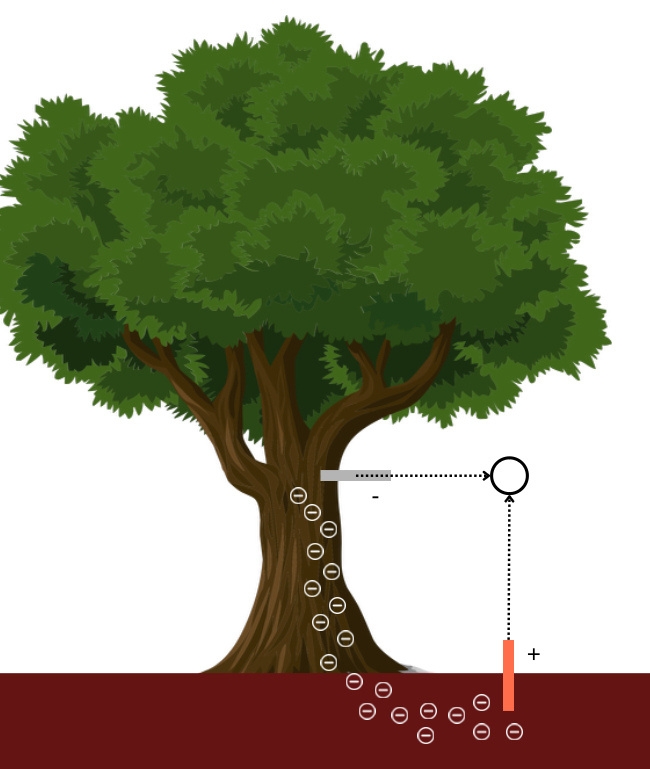
Image: Tree diagram showing MPD principle with underground root system and electrode placement

Design Objective

Ensure ΔE ≥ 0

This indicates that the system generates sufficient energy to cover its consumption, with surplus energy stored in the battery (Ebat), guaranteeing uninterrupted operation through nights and cloudy periods.
Hardware Design

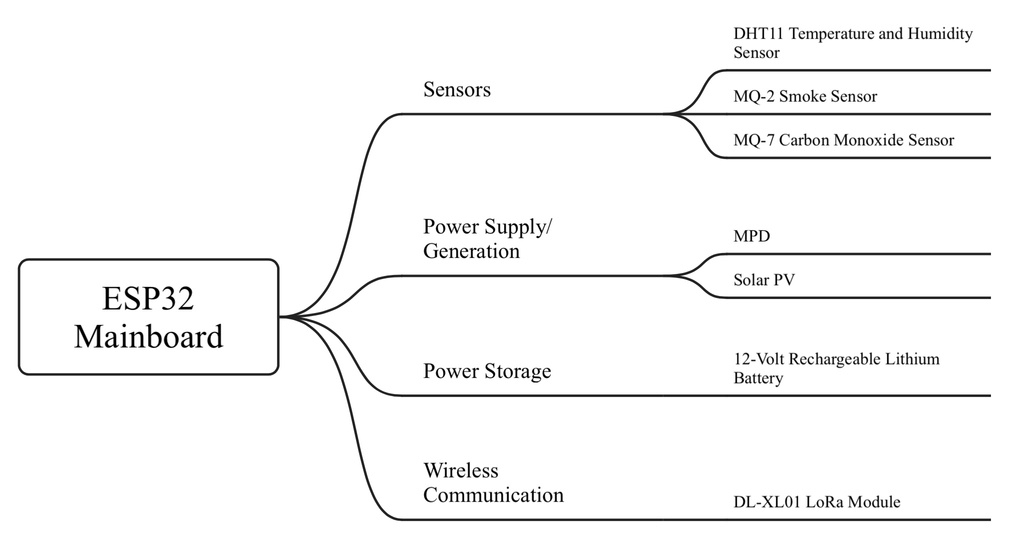
Image: Hardware flowchart showing ESP32 Mainboard connected to: Sensors (DHT11, MQ-2, MQ-7), Power Supply/Generation (MPD, Solar PV), Power Storage (12-Volt Rechargeable Lithium Battery), and Wireless Communication (DL-XL01 LoRa Module)

ESP-32 development board as the central processing unit to coordinate multiple specialized sensors: an MQ-7 CO sensor and an MQ-2 smoke sensor detect early fire signatures, a DHT11 temperature and humidity sensor analyzes environmental anomalies. All data is transmitted wirelessly over long distances via the DL-XL01 LoRa module. This highly integrated and power-optimized design ensures the long-term, stable operation of the monitoring terminal.

Hardware Components

All Hardware Components - Complete system showing ESP-32, MQ-2, MQ-7, DHT-11, and LoRa module

Complete hardware component assembly showing all sensors and communication modules

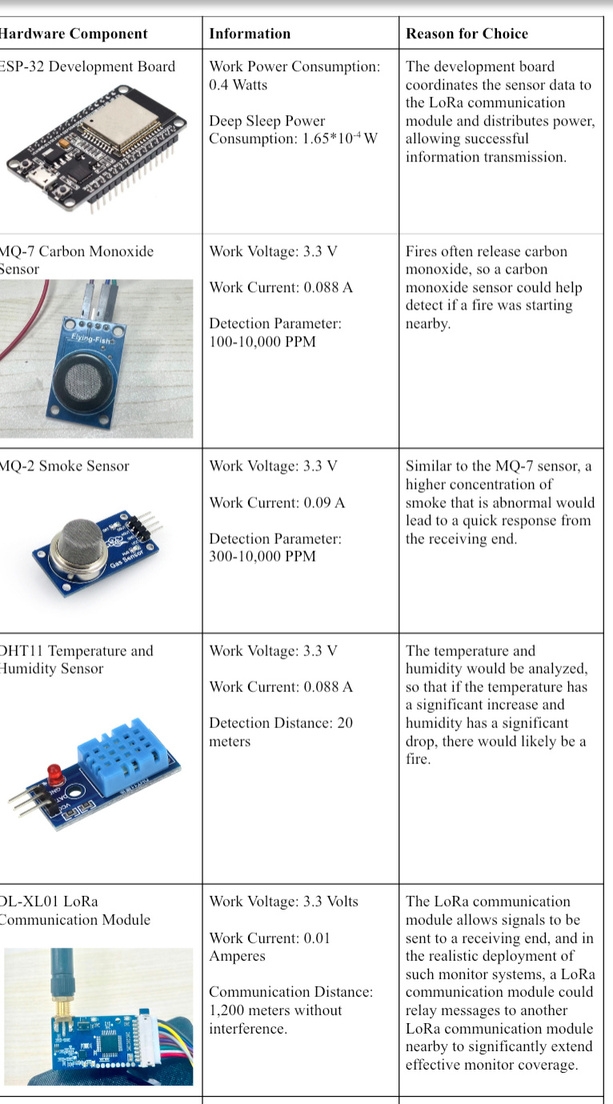
ESP-32 Development Board

Power Consumption: Work: 0.4 Watts | Deep Sleep: 1.65×10⁻⁴ W

Reason for Choice: The development board coordinates the sensor data to the LoRa communication module and distributes power, allowing successful information transmission.

MQ-7 Carbon Monoxide Sensor

MQ-7 Carbon Monoxide Sensor Module: A compact gas detection module specifically designed for carbon monoxide (CO) detection. It features a sensitive semiconductor material that changes resistance when exposed to CO gas, making it ideal for early fire detection through smoke analysis.

Work Voltage: 3.3 V

Work Current: 0.088 A

Detection Parameter: 100-10,000 PPM

Reason for Choice: Fires often release carbon monoxide, so a carbon monoxide sensor could help detect if a fire was starting nearby.

MQ-2 Smoke Sensor

MQ-2 Multi-Purpose Gas Sensor: A versatile gas detection module capable of sensing smoke, LPG, propane, methane, hydrogen, and other combustible gases. Its broad detection range makes it particularly effective for identifying various chemical signatures associated with early-stage fires.

Work Voltage: 3.3 V

Work Current: 0.09 A

Detection Parameter: 300-10,000 PPM

Reason for Choice: Similar to the MQ-7 sensor, a higher concentration of smoke that is abnormal would lead to a quick response from the receiving end.

DHT11 Temperature and Humidity Sensor

DHT11 Environmental Sensor: A basic digital temperature and humidity sensor module that provides reliable environmental monitoring data. This sensor is crucial for detecting abnormal temperature rises and humidity changes that often precede or accompany forest fires.

Work Voltage: 3.3 V

Work Current: 0.088 A

Sensing Range: 20 meters

Reason for Choice: The temperature and humidity would be analyzed, so that if the temperature has a significant increase and humidity has a significant drop, there would likely be a fire.

DL-XL01 LoRa Communication Module

DL-XL01 LoRa Communication Module: A long-range wireless communication module that enables data transmission over distances up to several kilometers with minimal power consumption. This low-power, long-range capability is essential for remote forest monitoring applications where traditional wireless networks are unavailable.

Work Voltage: 3.3 Volts

Work Current: 0.01 Amperes

Communication Distance: 1,200 meters without interference

Reason for Choice: The LoRa communication module allows signals to be sent to a receiving end, and in the realistic deployment of such monitor systems, a LoRa communication module could relay messages to another LoRa communication module nearby to significantly extend effective monitor coverage.

Power Consumption Calculation

Working Power (PWork):

PWork = PMQ-2 + PMQ-7 + PDHT11 + PLoRa + PESP32

= 0.3W + 0.29W + 0.033W + 0.04W + 0.4W = 1.064 W

Rest Power: PESP32-Rest = 1.65×10⁻⁴ W

Receiver System

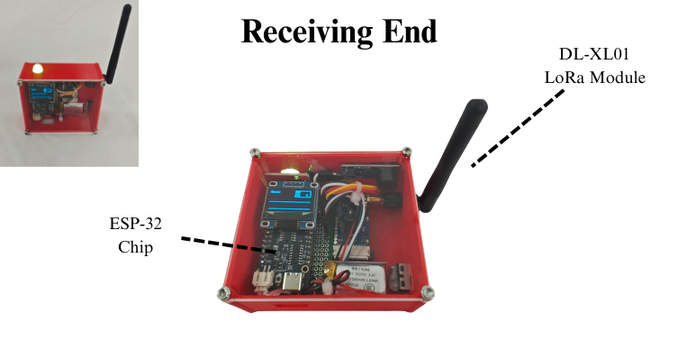
Image: Receiving End - showing red enclosure with ESP-32 Chip and DL-XL01 LoRa Module with antenna

The receiver unit features its own ESP-32 processor, DL-XL01 LoRa Module, OLED display screen, buzzer, and LED lights to alert forest rangers or monitoring station personnel of fire events.

Structural Design

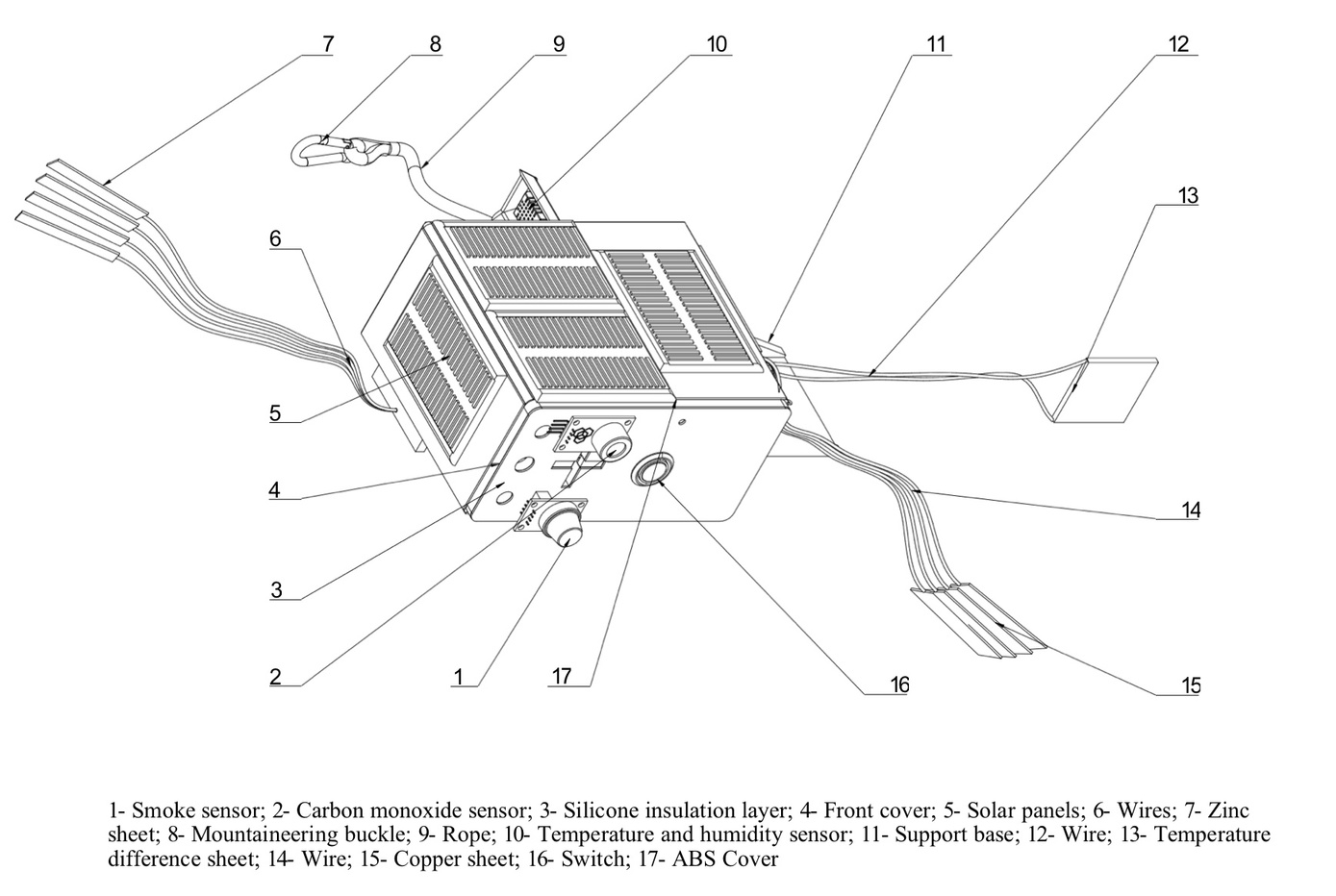
These figures and images depict the structure of the main monitor and receiving end, incorporating hardware components enabling local forest monitoring and the MPD-solar hybrid energy-providing system.

Image: Technical drawing showing labeled components

1- Smoke sensor; 2- Carbon monoxide sensor; 3- Silicone insulation layer; 4- Front cover; 5- Solar panels; 6- Wires; 7- Zinc sheet; 8- Mountaineering buckle; 9- Rope; 10- Temperature and humidity sensor; 11- Support base; 12- Wire; 13- Temperature difference sheet; 14- Wire; 15- Copper sheet; 16- Switch; 17- ABS Cover

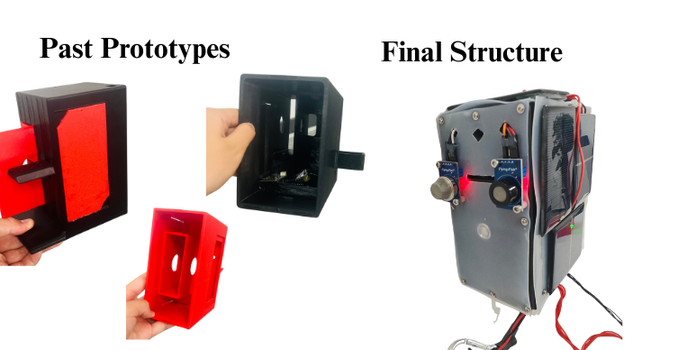
Development Evolution

Image: Past Prototypes showing red and black early versions alongside Final Structure with improved enclosure and sensor mounting

MPD Health Monitoring

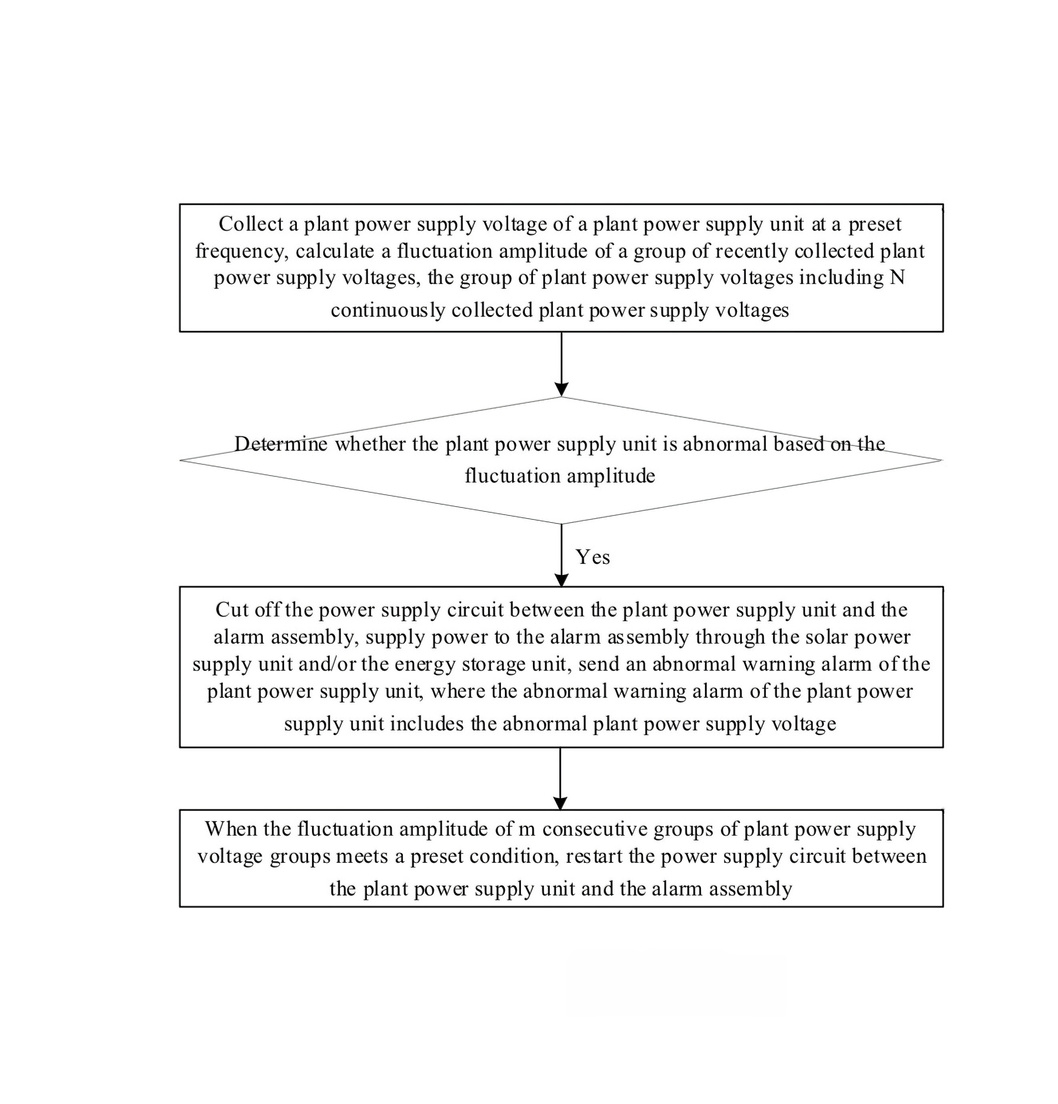
Monitoring Logic: The ESP32 samples U_MPD once every 5 minutes, continuously records 10 data sets, and calculates the fluctuation amplitude ((Max Value - Min Value) / Average Value × 100%).

Exception Handling

If the fluctuation amplitude is larger than 10% (for example, if U_MPD drops sharply from 0.84V to below 0.75V), it indicates abnormal plant metabolism (e.g., water deficiency, high temperature), triggering "MPD Sleep Mode."

System Response:

  1. Disconnect the MPD power supply circuit and switch to "Energy Storage + Solar" power supply
  2. Send an "MPD Abnormal Warning" via LoRa, including the U_MPD value at the time of abnormality
  3. After U_MPD consecutively returns to the ~0.84V range for three consecutive samples and fluctuations are ≤ ±10%, restart the MPD power supply and resume hybrid energy mode

Image: Flowchart showing MPD monitoring decision tree

Primary Powering Strategy

Sufficient Illumination

Solar panels power the device and charge the battery. When the battery state of charge (SOC) ≥ 90%, the charging module switches to constant voltage low current charging. Solar panels and the power generation unit share the load to prevent overcharging.

Weak Illumination

The solar power generation unit and the storage battery work together. The battery increases its power supply share to meet energy consumption needs.

No Illumination

When there is no light, the device enters low-power mode. The plant power generation unit works in conjunction with the storage battery, reducing the sampling frequency of the device to maintain basic consumption.

Battery Protection

  • Overcharge Protection: Stops charging and sends a warning if battery voltage or charge current becomes too high
  • Over-Discharge Protection: Forces the system into a deep dormancy state and sends a low-battery warning if the charge drops too low (e.g., <10% SOC)

Power Management Scenarios

Strong Illumination (Daytime)

Solar panels provide primary power, charging the battery while simultaneously powering the system. MPD provides supplementary support to ensure stable operation.

Weak Illumination (Cloudy/Dawn/Dusk)

Hybrid power mode activates with both solar and MPD contributing equally to maintain stable operation and battery charging during transitional lighting conditions.

No Illumination (Night)

MPD becomes the primary power source, maintaining continuous 24/7 operation by drawing from stored battery energy that was replenished during daylight hours.

Multi-Level Early Warning System

Level 1: Alert (Early Warning - Smoldering Detection)

Trigger:

Any parameter > 80% of baseline threshold:

  • Temperature: > 48°C (Normal forest daytime max < 38°C; 48°C indicates abnormal rise)
  • Smoke Concentration: > 240 PPM (Forest background smoke is very low; 240 PPM indicates light smoke from early smoldering)
  • CO Concentration: > 80 PPM (Normal CO is 1-5 PPM; 80 PPM is typical for smoldering stage)

Response:

Sampling interval reduced from 15 minutes to 2 minutes to intensively monitor early signs.

Level 2: Warning (Fire Confirmation)

Trigger:

Any parameter exceeds baseline threshold:

  • Temperature: > 60°C (Initial open flame temperature for surface litter/herbs)
  • Smoke Concentration: > 300 PPM (Transition from smoldering to open fire)
  • CO Concentration: > 100 PPM (Significant rise in early open fire)

Response:

Push notification to forestry fire patrol terminal + Sound alarm and LED indicator.

Level 3: Emergency (Fire Development)

Trigger:

More than 2 parameters simultaneously exceed baseline thresholds.

Response:

Continuous information push to command center + Fire spread warning, prompting for fire patrol dispatch.

Receiver System Alerts

The whole Blaze Scout system comprises the deployed hybrid-powered devices in the forest communicatively linked to one or more Receiver units.

The Receiver has its own display (OLED screen), buzzer, LED lights, and communication module to alert and provide detailed information to forest rangers or in a monitoring station.

Warning System Decision Flow

Normal State: The system samples environmental data every 15 minutes during normal conditions, conserving power while maintaining vigilance.

Level 1 Alert (Early Warning): When any parameter exceeds 80% of its threshold (Temp > 48°C, Smoke > 240 PPM, CO > 80 PPM), sampling frequency increases to every 2 minutes for intensive monitoring.

Level 2 Alert (Fire Confirmation): Upon detecting any single parameter exceeding its threshold (Temp > 60°C, Smoke > 300 PPM, CO > 100 PPM), the system triggers local sound/LED alarms and pushes notifications to patrol terminals.

Level 3 Alert (Fire Development): When more than 2 parameters simultaneously exceed thresholds, the system continuously pushes data to the command center and issues fire spread warnings.

Intellectual Property & Protection Strategy

A multi-faceted strategy to secure and enhance the value of the innovation.

Utility Patent

The core invention—the specific method of harvesting and managing MPD energy for continuous environmental monitoring—is the primary candidate for a utility patent. Claims cover the system architecture, Zn-Cu electrode application, and dynamic energy management algorithm.

Design Patent

The unique physical design and packaging of the device, which integrates the electrodes and electronics into a single functional unit, protected by design patents to prevent industrial copying.

Trademark

The "Blaze Scout" name and logo will be trademarked to build brand recognition and value in the environmental technology sector.